
There is a quiet miracle woven through the Scriptures, and once you see it, you cannot un-see it. It is the story of women — faithful, gifted, called women — whose presence at the very heart of Yehovah’s work was so strong, so undeniable, that no amount of editing, mistranslation, or human agenda could erase them. Their fingerprints are still on the sacred text. And that should fill all the daughters of Israel with hope.
They Gave the Mirrors — and Made the Basin
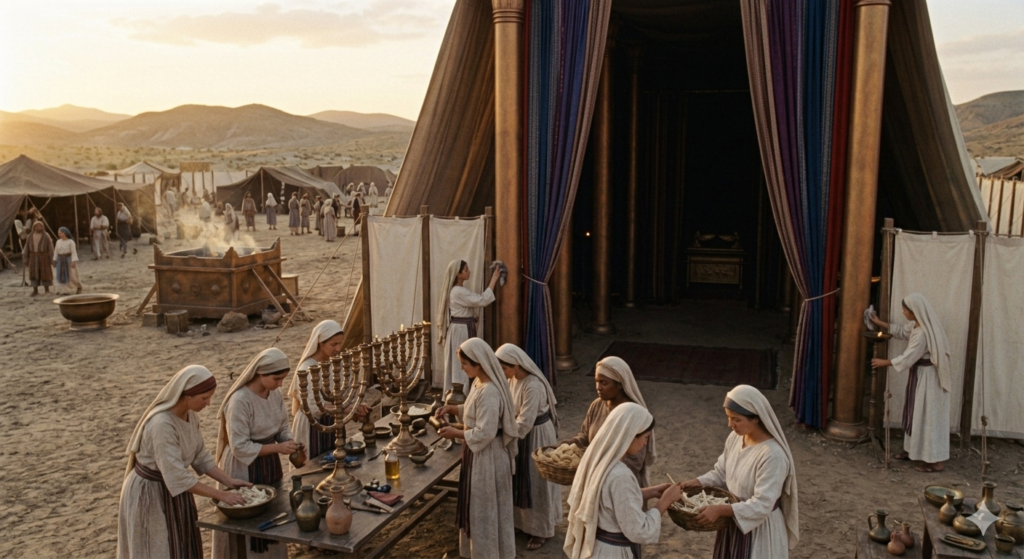
Picture the wilderness. The Tabernacle is rising, and the whole camp is bringing what they have. Among them are the tsov’ot — the ministering women who served at the door of the Tent of Meeting (Exodus 38:8). They bring their bronze mirrors, and from those mirrors, one object is made: the bronze basin.
This was not a minor object. The bronze basin was used by the priests to wash before entering holy service. Standing at the threshold of the Tabernacle, it became a visible witness that the offering of these women was woven into priestly preparation itself.
The word used for them, tsov’ot, comes from the Hebrew root tsava’. In many places, tsava’ carries a military sense — to go forth as an army, to wage war, or to serve in the hosts. It is the same root behind Yehovah Tsava’ot, “Yehovah of Hosts.” But that meaning does not fit Exodus 38:8. These women are not depicted as soldiers or guards at the Tabernacle door. In the Tabernacle context, tsava’ is also used for the appointed service of the Levites in Numbers 4 and 8. Read in that light, the women at the entrance were not casual bystanders. They were women rendering sacred service in connection with the Tabernacle — ordered, dedicated, and set apart. Women who ministered. Women who led. Women who served in a Levitical capacity.[1]

The language also echoes the way the Levites are “given” or assigned to sacred service in Numbers 8. There, the Levites are said to belong to Yehovah, wholly dedicated and given over to Him (Numbers 8:14, 16). Baruch Levine notes that the Hebrew verb natan (נתן), “to give,” can in certain cultic contexts carry the sense of compulsory assignment to sanctuary service.[2] Read this way, the women at the door of the Tent were not merely present by personal devotion; they were set apart for structured, appointed duty. And if their service was appointed by Yehovah, then the abuse committed by Hophni and Phineas becomes even more grievous: they violated women whom Yehovah Himself had set apart for holy work.
When Others Tried to Shrink Them, the Text Held On
Here is where the story becomes an encouragement rather than a grief. Over the centuries, translators struggled with these serving women. Some rendered them as “assembled,” others as “fasting,” “standing guard,” or “praying” — none of which captures the force of the Hebrew. Later traditions felt they had to defend the women’s honor, calling them “chaste,” as though their ministry needed an apology.
But notice: they could not remove them. The women are still there, in the text, doing their service at the door.
The same is true of Miriam. Rabbi Wendy Zierler notes that the very presence of the beginning — or title — of Miriam’s song in the Masoretic Text suggests that the tradition of her authorship was so powerful it could not be completely edited out. Marilyn Mansfield likewise argues that the restructuring of Exodus 15 appears to diminish the centrality of its female characters, and that what now appears in Exodus 15:20 as Miriam’s song may preserve an earlier beginning of the victory song itself. Even where the tradition was restructured,[3] and Miriam’s authorship was pushed aside, the text still bears witness: her song survived because her memory could not be erased.
There is another reason to hear Miriam’s voice at the center of that song: it belongs to a recognizable biblical tradition — the woman’s song. In Scripture, this tradition is marked by three elements appearing together: song, the hand-drum or tof, and dance. Exodus 15:20 explicitly gives the hand-drum and dance, while Miriam’s song is preserved in the surrounding victory tradition. Miriam the prophetess takes the timbrel in her hand, and the women go out after her with drums and dancing, lifting the song of victory. Zierler notes that wherever song, hand-drum, and dance appear together in biblical and extra-biblical texts, the performers are women. This was not incidental. Women were the traditional bearers of Israel’s songs of deliverance, giving the community its music of triumph. That is why the memory of Miriam’s authorship was too deeply rooted to disappear: the song still bears the marks of a woman’s hand.[4]
That is the heart of it. What Yehovah honors, no one can fully bury. The truth keeps surfacing.
A Great Cloud of Faithful Women
Once your eyes are open, you see them everywhere:
- Deborah — judge, prophetess, and leader of Israel, whom Nicolas Schaser describes as “the best of the judges.” The Hebrew phrase often translated “wife of Lapidoth” can also, as Schaser notes, be read as “woman of flames,” a fitting description of her prophetic fire and leadership.[5]
- Huldah — the prophetess who authenticated the found scroll and confirmed the word of Yehovah (2 Kings 22:15–16; 2 Chronicles 34:23–24).
- Miriam — sent before Israel alongside Moses and Aaron (Micah 6:4).
- Abigail — whose wisdom stopped David from rash bloodshed (1 Samuel 25:26, 31–33).
- Ruth — whose covenant loyalty carried the line of redemption forward.
- Esther — whose courage helped preserve her people from destruction.
- Hannah — whose prayer gave Israel a prophet (1 Samuel 1:10–11).
- Anna — the prophetess who never left the Temple and recognized Yeshua (Luke 2:36–38).
- Mary Magdalene — entrusted to be the first witness of the risen Messiah (John 20:11–18, Mark 16:9).
This is not a footnote to the story of faith. This is the story of faith.
Even Their Titles Were Diminished
Even Ruth’s strength was softened in translation. In Ruth 3:11, Boaz calls her an eshet chayil — the female counterpart to the language of chayil used elsewhere for strength, valor, capacity, wealth, and public standing. Boaz himself is introduced with chayil language in Ruth 2:1, though English translations vary between “man of standing,” “man of wealth,” “worthy man,” and similar renderings. Yet when the same root is applied to Ruth, English translations often narrow it to “virtuous woman.” Virtue is beautiful, but the Hebrew says more. Ruth is being recognized as a woman of covenant courage, social weight, and honorable strength. The text does not make her small; translation often does.[6]
The pattern did not end with the women of the Tanakh. In the New Testament, women are honored with words that later readers often tried to soften. Phoebe is called a diakonos of the assembly at Cenchreae — a word often rendered “minister” or “deacon” when applied to men, but softened to “servant” when applied to her. Paul also calls her a prostatis, a word carrying the sense of patron, benefactor, protector, or one who stands before others in support and authority — yet this, too, has often been softened to “helper.” Junia is named by Paul as outstanding among the apostles, yet later tradition sometimes turned her into “Junias,” as though an apostolic woman had to be explained away. Mary Magdalene was entrusted as the first witness of the risen Messiah, yet later teaching often reduced her to a symbol of shame rather than remembering her as a commissioned witness.[7]
And still the text held on. At Pentecost, Peter did not announce a Spirit poured out only on sons; he quoted Joel 2: “your sons and your daughters shall prophesy.” Philip’s four daughters did exactly that, and Acts remembers them as women who prophesied (Acts 21:9). Joanna, Susanna, Mary Magdalene, and many others supported Yeshua’s ministry from their own resources (Luke 8:1–3). The Samaritan woman’s testimony brought many in her city to Him (John 4:28–30, 39). Again and again, Scripture remembers women speaking, serving, funding, witnessing, and prophesying — even where later tradition tried to make them smaller.[8]
And What of the “Silencing” Verses?
Many sincere believers have been wounded by a handful of passages that seem to silence women. But honesty with the text brings freedom. The first is the line, “let your women be silent,” in 1 Corinthians 14:34–35. These verses do not sit securely in the manuscript tradition: in most copies, they appear after verse 33, while in Western witnesses, they move to the end of the chapter, after verse 40. That kind of “wandering” is unusual for material scribes regarded as original and fixed.
The evidence strengthens the concern. Codex Vaticanus, one of the oldest complete Bibles, contains a marginal mark at this point that signals a textual variant. Bishop Victor of Capua later treated the passage as doubtful in Codex Fuldensis, placing the text in the margin rather than the main body. Early church writers also do not lean on these verses, even when arguing about women’s roles. Dr. Nicolas Schaser notes that no Church Father — not even Tertullian, who was willing to argue critically about women — cites these verses, a striking silence if they had stood securely in Paul’s letter. Taken together, the movement of the verses, the manuscript markings, and the unusual number of variants all point to a likely later insertion rather than Paul’s original words.[9]
The second passage, “let a woman learn in silence” in 1 Timothy 2:11–14, raises a different question. That passage goes on to say, “I do not permit a woman to teach or to have authority over a man,” appealing to Adam being formed first and then Chavah (Eve). Yet in Romans 5:12, Paul places the entrance of sin through “one man,” not through the woman. That tension matters when asking whether 1 Timothy speaks with Paul’s own voice.
Here, the issue is not a wandering verse but the authorship of the whole letter. 1 and 2 Timothy and Titus — the Pastoral Epistles — differ from Paul’s undisputed letters in vocabulary, church structure, and theological emphasis.[10] They are also frequently concerned with the administration of the assembly as an established institution, with a more developed hierarchy of offices. That emphasis fits less naturally within Paul’s lifetime and his concern for Spirit-led ministry, and more naturally within the growing institutional structure of the late first or early second century.[11]
Paul died around 64–67 CE, yet many scholars date the Pastoral Epistles well after his lifetime, often toward the end of the first century or into the early second century, with some placing them around 120–150 CE. The manuscript and reception history also warrant caution. Marcion, an early second-century follower of Paul and one of the earliest canon-makers, included Paul’s letters but left out the Pastorals. Jerome records that Marcion, Basilides, and others rejected the Pastorals, and that Tatian accepted Titus but not 1 or 2 Timothy. Papyrus 46, our earliest surviving collection of Paul’s letters, does not preserve the Pastorals; Schaser also notes their absence from Codex Vaticanus as part of the broader reception-history argument.[12]
So when we ask what Paul actually thought of women, his undisputed letters give us our clearest evidence. He honored Phoebe the deacon, Priscilla his coworker, Junia, notable among the apostles, and Euodia and Syntyche, who labored beside him in the gospel. And he declared the great equalizing truth of the Kingdom: in Messiah Yeshua, there is neither male nor female — we are one in Him (Galatians 3:28).
Be Encouraged
Daughters of Israel, if you have ever wondered whether there is a place for you in the service of the Holy One — the Scriptures answer you. There always has been. Yehovah wove women into the very construction of His dwelling place, into the songs of deliverance, into the prophetic word, into the first testimony of the resurrection.
And may the brothers walk in step with this truth, too — honoring what Yehovah honors and making room, as Yeshua and Paul did, for the gifts He has placed in the daughters of Israel.
The agenda of later tradition could bend the translations, shuffle the verses, and blur the credits. But it could never remove the women from the story. Because Yehovah never forgot them.
And, daughters of Israel, He has not forgotten you!
For more teachings and source notes, visit ProjectTruthMinistries.org.
[1] Nicolas Schaser, “Women in the Tanakh,” video series, Israel Bible Center; Marilyn Mansfield, “The Ministering Women and Their Mirrors,” University of Sydney, Australia. Separately, Ismar Peritz, Joyce Baldwin, and other scholars argue that the Hebrew root tsaba’ can denote rendered service in connection with the Tabernacle, including service understood in a Levitical or cultic capacity.
[2] Baruch A. Levine notes that the Hebrew verb natan (נתן), “to give,” can in certain cultic contexts carry the sense of compulsory assignment to sanctuary service; see Numbers 8:14, 16.
[3] Marilyn Mansfield, PhD, argues that the restructuring of Exodus 15 appears to diminish the centrality of its female characters, and that what now appears in Exodus 15:20 as Miriam’s song may preserve an earlier beginning of the victory song itself
[4] Wendy Zierler, “Re-Encountering Miriam,” TheTorah.com, 2016, https://www.thetorah.com/article/re-encountering-miriam; Phyllis Trible, “Bringing Miriam out of the Shadows,” Bible Review 5 (1989): 19–20; Marilyn Mansfield, “The Ministering Women and Their Mirrors,” University of Sydney, Australia.
[5] Nicolas Schaser notes that Judges 4:4 describes Deborah as ishah neviah eshet lapidot — commonly translated “a woman prophet, the wife of Lapidoth,” but also capable of being read as “a woman prophet, a woman of flames.” See Judges 4–5 and Schaser, “Women in the Tanakh,” Israel Bible Center.
[6] In Ruth 3:11, Boaz calls Ruth an eshet chayil, a phrase built from the same Hebrew root chayil used elsewhere for strength, valor, wealth, capacity, and public standing. When applied to men, including Boaz in Ruth 2:1, the term is often rendered “man of standing,” “mighty man,” or “valiant man”; when applied to Ruth, many English translations narrow the phrase to “virtuous woman.”
[7] Romans 16:1 describes Phoebe as a diakonos of the assembly at Cenchreae, a word often rendered “minister” or “deacon” when applied to men but softened to “servant” when applied to her. Romans 16:2 also calls Phoebe a prostatis, a term associated with patronage, protection, leadership, and standing before others in support, though it has often been reduced to “helper.” Romans 16:7 names Junia as notable “among the apostles,” though later interpretation sometimes shifted the phrase to “known to the apostles” or masculinized her name as “Junias,” obscuring the witness of a female apostle. Mary Magdalene is remembered in John 20:11–18 as the first witness of the risen Messiah, though later tradition often conflated or reduced her identity.
[8] Joel 2:28–29; Acts 2:17–18; Acts 21:9; Luke 8:1–3; John 4:28–30, 39.
[9] Nicolas Schaser, discussion of 1 Corinthians 14:34–35, textual variants, Codex Vaticanus, Bishop Victor of Capua, Tertullian, and the interpolation question, Israel Bible Center.
[10] The Oxford Study Bible, ed. M. Jack Suggs, Katharine Doob Sakenfeld, and James R. Mueller (New York: Oxford University Press, 1992), 1506.
[11] Dan McClellan, discussion of the dating, reception history, and authenticity of the Pastoral Epistles, The Bible Says So.
[12] Nicolas Schaser, discussion of the reception history of the Pastoral Epistles, including Marcion, Jerome, Tatian, Papyrus 46, Codex Vaticanus, and the question of Pauline authorship, Israel Bible Center.slow, that is okay—Moses spent forty years in the wilderness, so you are allowed to take your time with a verb form.